
Our Dispute Resolution Team led by our Managing Partner, Nitesh Jain recently appeared before the Hon’ble High Court of Delhi in a significant matter concerning a recurring issue in modern commercial transactions—whether exchanged drafts, negotiations, WhatsApp communications, and commercial dealings can, by themselves, constitute a binding arbitration agreement.
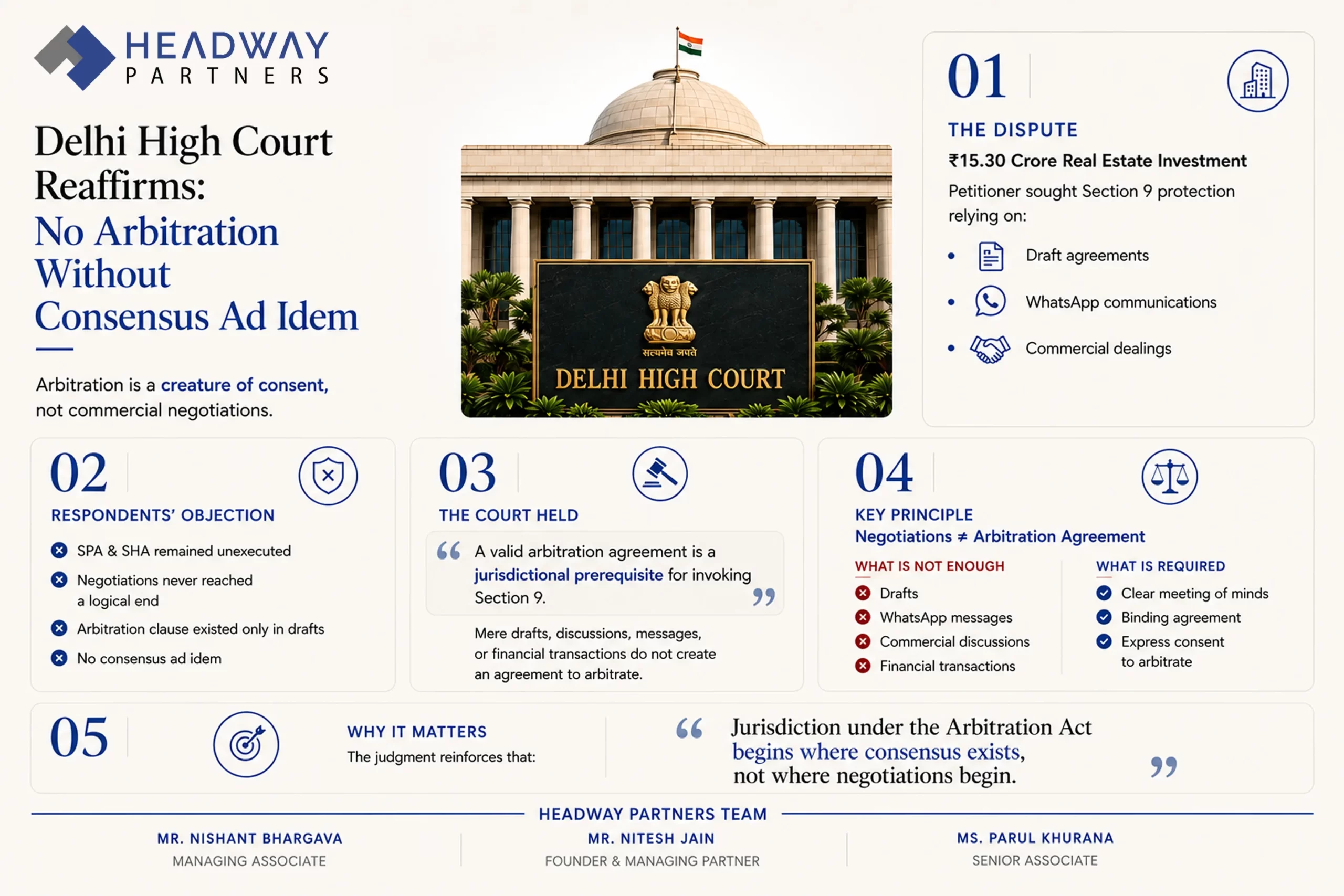
The dispute arose from a proposed investment transaction involving approximately ₹15.30 crore in relation to a real estate project. The Petitioner sought interim protection under Section 9 of the Arbitration and Conciliation Act, 1996, relying upon draft transaction documents, electronic communications, and the parties’ commercial dealings to contend that disputes were referable to arbitration.
The Respondents, however, raised a foundational jurisdictional objection: there can be no invocation of arbitral remedies unless there first exists a valid and enforceable arbitration agreement. It was contended that the Share Purchase Agreement and Shareholders’ Agreement remained unexecuted, negotiations never culminated into a concluded contract, and the alleged arbitration clause formed part of draft documents which never attained finality.
Accepting the Respondents’ submissions, the Hon’ble High Court, vide Judgment dated 29.05.2026 in O.M.P.(I)(COMM.) 30/2026, dismissed the petition and held that the existence of a valid arbitration agreement is not a procedural formality but a jurisdictional prerequisite for the exercise of powers under Section 9.
Significantly, the Court drew a clear distinction between commercial negotiations and contractual finality. The Hon’ble High Court held that mere exchange of drafts, WhatsApp communications, discussions regarding commercial terms, or even financial transactions cannot substitute the statutory requirement of consensus ad idem. Unless there is a clear meeting of minds resulting in a binding agreement to arbitrate, courts cannot exercise jurisdiction under the Arbitration Act.
The judgment assumes particular significance in an era where businesses increasingly rely on informal communications and evolving negotiations to structure high-value transactions. The decision serves as a reminder that while commercial discussions may progress through emails, messages, and draft documents, arbitration remains a creature of consent, and consent cannot be presumed from incomplete negotiations.
The ruling therefore reinforces an important principle of arbitration jurisprudence: the pro-arbitration approach of courts does not dispense with the threshold requirement of proving the existence of a valid arbitration agreement. Jurisdiction under the Arbitration Act begins where consensus ends not where negotiations begin.
The Respondents were represented by Mr. Akhil Sibal, Senior Advocate, along with Mr. Nitesh Jain, Founder & Managing Partner, assisted by Mr. Nishant Bhargava, Managing Associate and Ms. Parul Khurana, Associate.