
Delhi’s Transit Oriented Development story has had two chapters. The first, written in July 2021, was theoretically sound but practically unworkable for most private landowners. The second, notified by the Central Government on 6 April 2026, is a fundamental course correction — and one that every landowner, developer and investor holding land near Delhi’s expanding metro and RRTS network must read carefully.
At Headway Partners, we have studied both notifications in detail. This note sets out what the old policy got wrong, what the new policy has fixed, and precisely why this matters for your land and your balance sheet.
The 2021 Policy and the Fallout
The 2021 TOD Policy was designed as a large-scale urban design exercise. It required the assembly of a minimum 1 hectare “TOD Scheme” with at least 25% of the area inside a designated Intense Development Area, multi-owner aggregation through legally enforceable agreements, the creation of a detailed Influence Zone Plan, mandatory 20% green public space handed over to local bodies, a complex use-mix matrix computed individually for each constituent plot, multi-agency approvals through an LG-chaired committee, and no defined timeline for sanction.
In short, the policy was designed for institutional parcels — large government land banks, housing colonies or industrial estates where a single agency could act as the sole Developer Entity. For the vast majority of private landowners along Delhi’s metro corridors, the entry threshold was simply too high. Four years passed with almost no private participation. The policy, though notified, remained a paper provision.
What Changed on 6 April 2026
The new TOD Policy, notified as a modification to MPD-2021, reimagines TOD from the ground up.
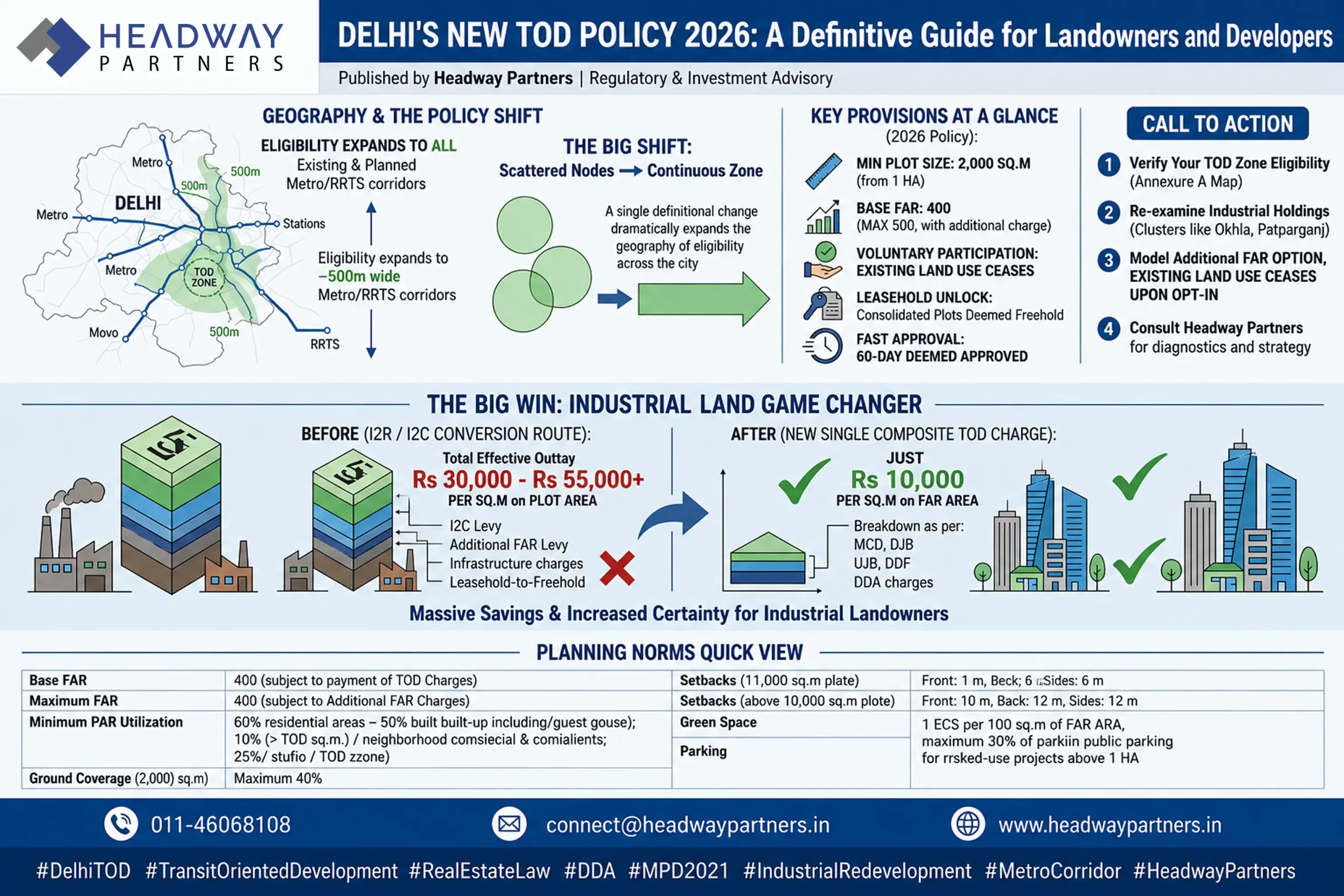
Instead of scattered, DDA-selected nodes, the policy now creates a continuous TOD Zone — defined as a 500 m wide corridor on both sides of the center line of every existing and planned/approved metro corridor in Delhi, and a 500 meter radius around every regional and interstate transit station, including RRTS, Railway and High Speed Rail stations. This single definitional change dramatically expands the geography of eligibility across the city. New metro corridors and RRTS stations are automatically absorbed into the TOD Zone as and when planned or approved — no separate DDA notification is required.
The minimum unit of development has been reduced from 1 hectare to a TOD Plot of 2,000 sq.m, requiring at least 50% of the plot to fall within the TOD Zone. A single landowner or a group of owners holding 2,000 sq. meters or more, with road access of at least 18 m ROW, can now independently apply for TOD.
The Most Important Provision: Voluntary Participation, but with a Powerful Consequence
The 2026 policy is explicit: participation under TOD is entirely voluntary. No landowner is compelled to opt into the TOD regime. Those who choose not to may continue their existing activities as per the prevailing Master Plan provisions.
However, the policy carries an equally important consequence: once a landowner opts into TOD, the existing land use assigned under the Master Plan ceases to apply to that development. The TOD development controls — the FAR, the use-mix, the building norms — fully supersede the underlying land-use designation. The project is thereafter governed entirely by TOD norms and approved by the TOD Committee, not by the old land-use rules or by local body approvals for that land use.
This is not a minor procedural point. It means a plot tagged as “Industrial” or “Transportation” or “Government” in the Master Plan can, voluntarily, step out of that designation entirely and develop as a high-density, mixed-use TOD project — simply by opting in, complying with TOD norms, and paying the prescribed charges.
The Industrial Land Game Changer
This is perhaps the single most significant benefit buried in the 2026 policy, and one that has not received adequate attention.
Delhi’s industrial clusters along the metro network — Okhla, Mohan Co-operative, Patparganj, Mayapuri, Lawrence Road, Wazirpur, Badli, Jahangirpuri and others — have for years been economically unviable for industrial use. Landowners have wanted to convert to residential or commercial uses, but the path under the existing framework has been both expensive and uncertain.
Under the Industrial-to-Residential (I2R) and Industrial-to-Commercial (I2C) conversion notification, the conversion charge alone varied from Rs 14,328 to Rs 24,777 per sq.m of plot area depending on the location, with additional FAR charges of Rs 3,039 to Rs 7,597 per sq.m over and above. Apart from these Infrastructure charges of DJB, leasehold to freehold conversion charges varying from Rs 12,000 per Sq. meters on plot area were also payable additionally. The total effective outlay to convert an industrial plot to residential or commercial use, before even starting construction, therefore ranged from approximately Rs 30,000 to over Rs 55,000 per sq.m of land — and this was charged on the plot area, not on the built-up FAR area. For commercial use, the charges were 1.25 times higher still.
The 2026 TOD policy changes this calculus entirely. The TOD framework explicitly covers Residential, Commercial, Industrial, Government and Transportation land uses within the TOD Zone, and the policy states clearly that once a TOD project is approved by the TOD Committee, the existing land-use activities are superseded. The Regulations for TOD and Charges, 2026, create a single composite TOD Charge of Rs 10,000 per sq.m of FAR area — which is explicitly stated to be all-inclusive, covering DJB infrastructure charges for water and sewer, MCD plan sanction charges including land-use change levy and additional FAR levy, DDA’s plan approval charges, and DDA’s leasehold-to-freehold conversion charge. No separate I2R or I2C conversion charges are prescribed or required under this regime.
The arithmetic is stark. What previously cost Rs 32,000 to Rs 55,000 per sq.m on the plot area under the old I2R/I2C route, now costs Rs 10,000 per sq.m on the FAR area under TOD — and that single payment is comprehensive, covering all agencies. For an industrial landowner opting into TOD and building to FAR 400, the savings are enormous, and the certainty is incomparably higher.
Additionally, individual industrial plots held on a leasehold basis from DDA, once consolidated into a TOD Plot and all outstanding dues are cleared, shall be deemed freehold — a significant title and valuation unlock in its own right.
Planning Norms at a Glance: New TOD Policy 2026

How the Charges Work
The 2026 Regulations for TOD and Charges create an unusually clean pricing structure.
TOD Charges (for FAR up to 400): A flat, composite rate of Rs 10,000 per sq.m of FAR area, uniform across all colonies in Delhi. This is not an additional levy on top of existing charges — it replaces and consolidates them. The distribution is:
-
- MCD — Rs 3,000 per sq.m (plan sanction and related charges)
-
- DJB — Rs 3,000 per sq.m (water and sewer infrastructure charges)
-
- Urban Development Fund — Rs 2,500 per sq.m (city infrastructure)
-
- DDA — Rs 1,500 per sq.m (plan approval charges)
Additional FAR Charges (for FAR between 400 and 500): Equal to 20% of the prevailing circle rate applicable to the location, as notified by the Department of Revenue, GNCT Delhi, charged per sq.m of FAR area beyond 400.
Both sets of charges are deposited upfront at the time of application through OBPS and ring-fenced in a dedicated TOD Fund Escrow, to be used exclusively for area improvement and infrastructure augmentation in the TOD Zone.
At Rs 10,000 per sq.m, the base TOD FAR cost translates to approximately Rs 929 per sq.ft — firmly below Rs 1,000 per sq.ft, and all-inclusive. For context, this is the total government impost for building at FAR 400 in mixed-use, high-density development near a metro station in Delhi.
How Delhi’s TOD Compares with Haryana and Noida / GNIDA
For investors and developers active across the NCR region, a comparative overview of FAR cost and development conditions is instructive.
Haryana (Gurugram / Faridabad corridor): Haryana’s TOD policy, notified in 2016 and amended thereafter, is structured around a licensing framework. Any developer wishing to develop under TOD norms in Haryana must first obtain a license, pay License Fee, Conversion charges, External Development Charges (EDC), Infrastructure Development Charges (IDC) and Infrastructure Augmentation Charges (IAC) — all levied separately and in addition to the license fee. EDC rates for Group Housing in Gurgaon, for instance, translated around Rs 650 per sq.ft of built-up area, and IDC adds further. Alongwith double EDC, License fees, Infrastructure augmentation charges and other charges themselves are substantial and zone-dependent. Taken together, the all-in government impost per sq.ft of FAR area in Haryana’s TOD corridors is considerably higher than Delhi’s sub-Rs 1,000 per sq.ft framework, and the process involves multiple state agencies, complex approval framework and is subject to periodic revision without a fixed composite rate structure.
Noida / GNIDA: Noida and Greater Noida operate on a land allotment model where FAR is largely embedded in the plot allotment premium. Additional purchasable FAR, where available, is priced as a percentage of the prevailing allotment rate or circle rate — which in premium sectors can translate to FAR costs well above Rs 1,500 to Rs 3,000 per sq.ft of additional built-up area. There is no single, transparent, composite charge mechanism comparable to Delhi’s Rs 10,000 per sq.m structure.
The contrast is clear. Delhi’s 2026 TOD framework, with its transparent pricing, composite single-window charge, 60-day deemed approval, and an effective base FAR cost of under Rs 1,000 per sq.ft, is the most investor-legible TOD framework in the NCR region today. For landowners who have held legacy parcels — particularly industrial plots — near Delhi’s transit corridors, this policy creates an arbitrage opportunity that does not presently exist in comparable measure in either Haryana or the Noida/GNIDA jurisdiction.
What Should Landowners and Developers Do Now
The 2026 TOD Policy is not an incremental update. It is a structural re-opening of one of Delhi’s most underutilized planning tools, with specific provisions that were deliberately crafted to address the failures of the earlier regime.
If you own or control land along any metro or RRTS corridor in Delhi, the immediate priorities are:
-
- Verify your TOD Zone eligibility against the TOD Zone Map published as Annexure A to the new notification; the 500 m corridor definition is wider and more continuous than anything in the 2021 framework.
-
- Re-examine industrial holdings in clusters like Okhla, Mohan Co-operative, Patparganj, Mayapuri, Lawrence Road, Wazirpur or Badli against the TOD route — without the burden of the old I2R/I2C conversion charges, the economics of redevelopment under FAR 400–500 have changed materially.
-
- Revisit stalled or previously unviable projects in the TOD Zone that could not be taken forward under the 1 Ha minimum requirement; the 2,000 sq.m threshold now makes many of those plots independently actionable.
-
- Model the Additional FAR option — buying FAR up to 500 at 20% of circle rate may be highly accretive in locations where end-use values are strong and circle rates are moderate.
-
- Track leasehold status — the deemed freehold provision for consolidated TOD plots, upon clearance of dues and resolution of encumbrances, can independently generate significant balance-sheet value.
At Headway Partners, we are advising clients on end-to-end TOD diagnostics — from eligibility mapping and land-use status opinion to financial modelling, transaction structuring and approval strategy under the new framework. If you own or wants to develop land within 500 metres of a metro or RRTS route in Delhi, this is the right moment to take a precise, legal and financial view of your options.
We welcome inquiries and conversations. You may call us at +91-11-4068108, write to us at connect@headwaypartners.in or connect through our website www.headwaypartners.in
Headway Partners
Land I Regulatory I Dispute Resolution I Policy Advisory I Real Estate Investments