
India’s environmental clearance regime has just been redrawn by the Supreme Court. In its judgment dated 29 July 2026 in W.P.(C) No. 1394 of 2023 and connected matters, the Court held that prior environmental clearance (EC) under the EIA Notification, 2006 is mandatory and non-negotiable, upheld the 2017 Notification only as a narrow one-time violation-management measure, and struck down the 2021 Office Memorandum (OM) prospectively for creating an unauthorised, open-ended post-facto clearance route.
The Bench framed the underlying tension in unusually candid terms, invoking a Gandhian formulation to describe the balance it was being asked to strike:
“In an anthropocentric world where man shapes nature to meet his wants, this Bench is entrusted with the solemn duty to strike a balance between an existential right of all living beings — both present and future — to a pollution-free environment and an aspirational right to development of a sixth of the world’s population… ‘The world has enough for everyone’s need, but not enough for everyone’s greed.'”
For developers, infrastructure companies, industrial operators, RERA-registered promoters and their approval teams, this is not just an environmental law update — it is a compliance-strategy judgment. It directly affects project sequencing, land diligence, lender risk assessment, and the timeline discipline that RERA-registered projects are already required to maintain.
The Core Legal Question: Can a Project Get Clearance After It Has Already Started?
The dispute traces back to two instruments issued by the Ministry of Environment, Forest and Climate Change (MoEFCC): the 2017 Notification and the 2021 OM, both of which allowed appraisal and grant of environmental clearance to projects that had already commenced construction or operation without obtaining prior EC.
The Court’s own summary of the philosophy underlying the 2006 Notification is worth quoting directly, because it captures the reasoning that runs through the entire judgment:
“The 2006 Notification articulates the vital precautionary principle… Text of the notification and its core philosophy — which may be loosely termed as ‘look before you leap’ — and the prescribed consequences, namely prosecution now, civil penalty [later], unequivocally point in one direction, namely its mandatory import.”
Five Key Holdings
The Court’s ruling can be distilled into five operative propositions with direct bearing on real estate and infrastructure compliance.
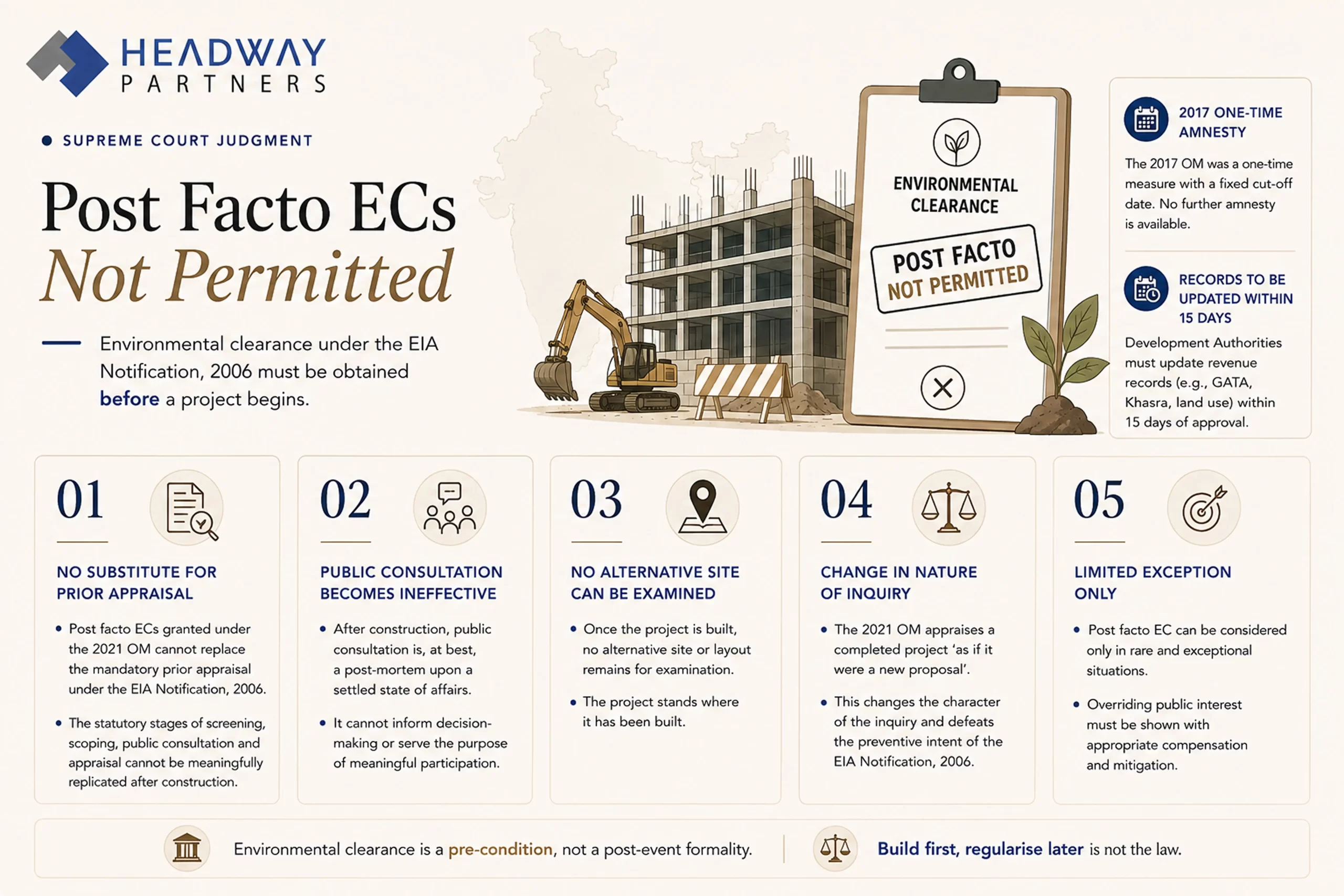
- Prior EC is mandatory. The EIA Notification, 2006 explicitly uses the word “prior,” and construction or land preparation beyond securing the land cannot begin before clearance is granted.
- The 2017 Notification survives — but only as a closed, one-time window. It applied exclusively to projects already in violation as of 14 March 2017, and its window has long since closed.
- The 2021 OM is struck down (prospectively). An executive office memorandum cannot lawfully create a perpetual, undated route for regularising projects commenced without prior EC.
- Existing clearances remain protected. ECs already granted under either instrument stand, unless independently challenged on project-specific merits.
- No new applications under either route. Pending applications may be processed to conclusion, but fresh reliance on the 2017 Notification or 2021 OM is no longer available.
On the central question of whether a breach can simply be “cured” by paying a penalty, the Court was unusually direct:
“We are unable to subscribe to the view that such silence would permit a wrongdoer to continue enjoying the usufructs of his wrongdoing. Prosecution/penalty punishes the wrongdoer for the breach. Its imposition cannot be a justification to condone a void act committed in violation of a mandatory provision of law.”
Why the 2017 Notification Survived Scrutiny
This distinction is the technical heart of the judgment, and it matters for anyone advising on regulatory risk. The Court did not endorse ex post facto EC as a general principle — it approved a narrowly bounded, one-time statutory scheme, and rejected a continuing administrative shortcut. On the nature of such schemes, the Court observed:
“The exception so carved is in the nature of an amnesty. It draws projects in breach of the prior EC mandate back within the regulatory framework, upon adequate deterrence, rather than leaving them unchecked… the precautionary principle stands as the rule and a bounded amnesty may stand as the exception.”
The 2017 Notification qualified as valid delegated legislation because it was issued under the Environment (Protection) Act, 1986 and the accompanying Rules, followed prior publication and public objections, applied only to a closed class of projects already in violation on a fixed date, required central-level appraisal, and mandated damage assessment, remediation and compensatory liability. The Court’s final verdict on the Notification was carefully qualified:
“So tested, the 2017 Notification is valid, but within narrow limits alone… Nor does it create an open class of future violators, both eligibility and duration being closed.”
Why the 2021 OM Failed
By contrast, the 2021 OM was only an executive instruction — it never went through the rule-making safeguards required to amend a statutory notification. The Court’s comparative table in the judgment draws a sharp technical line between the two instruments, noting that under the 2006 regime “screening and scoping… are antecedent to and govern the activity,” whereas under the 2021 OM, “no genuine screening or scoping is feasible” because “the Committee appraises the completed project as if it was a new proposal” — after the fact.
The Court warned that repeated executive relaxations of this kind risk turning exception into rule, echoing the National Green Tribunal’s own words in an earlier round of this very controversy:
“Repetitive condonation of violation of law would only aim at encouraging violators to flout the law repeatedly… The doctrine of necessity does not operate on the axis of illegality and violations.”
The Madras High Court’s finding in the related Fatima case — which this Bench substantially endorses — is equally quotable for its plain-spoken characterisation of what had happened to the “exception”:
“The impugned OMs, by making ex post facto EC a routine, across-the-board affair, converted what should be an exception into a rule/norm through a barrage/slew of instructions which have been issued one after the other in succession, making it a new normal.”
Environmental appraisal under the EIA Notification, 2006 unfolds in four stages — screening, scoping, public consultation, and appraisal — each intended to operate before a project commences. Explaining why an ex post facto process cannot substitute for this framework, the Court observed that once a project has been completed, “no alternative site can be examined. The project stands where it has been built,” while public consultation after construction is, “at best, a post-mortem upon a settled state of affairs.”
For real estate and infrastructure teams, the message is direct: EC is not paperwork appended at the end of planning — it is part of the technical design process itself, comparable to structural or fire-safety review in terms of sequencing importance.
What This Means for Real Estate
Real estate projects crossing 20,000 sq. m. of built-up area require environmental clearance — thresholds that apply squarely to group housing, townships, integrated commercial developments and institutional campuses common across the NCR and UP development corridors.
With RERA authorities now routinely requiring promoters to certify or furnish timelines for environmental clearance as part of project registration, the Supreme Court’s ruling adds direct regulatory weight to what was already a RERA compliance checkpoint.
Practical implications for developers include:
- EC screening must happen at the land-evaluation stage, not after commercial commitments, marketing plans or construction mobilisation are locked in.
- Threshold and category analysis (Form 1/1A) needs early legal-technical review, especially for phased townships where cumulative built-up area may cross regulatory thresholds unexpectedly.
- Expansion and product-mix changes can trigger fresh EC requirements, so mid-project redesigns should be checked against category rules before execution.
- Payment of environmental compensation does not cure a defective start — the judgment forecloses reliance on penalty-and-continue as a compliance strategy.
- No project should assume a future OM or informal departmental practice will provide a regularisation route — that door has been closed by this ruling.
When the Court Will Still Show Flexibility
Importantly, the judgment does not treat every violator identically. It draws a sharp line between violators who acted purely for private commercial gain and those whose completed projects implicate genuinely innocent third parties:
“A violator whose project serves an overriding public interest, protects innocent third-party interests, maintains an essential public utility or itself advances an environmental object may be placed in a class different from a violator whose project serves only private commercial gain.”
But the Court is equally emphatic that this flexibility is not a licence to build first:
“None of them holds that a proponent may build first and then claim regularisation upon the strength of the completed construction.”
This is precisely why cases like Goel Ganga Developers and Keystone Realtors, cited approvingly in the judgment, resulted in heavy monetary damages (up to Rs. 100 crore or 10% of project cost whichever is higher, ₹1 crore deposit and directed environmental mitigation through an expert committee) and refunds to third-party purchasers with interest @9% rather than outright demolition — the equities of protecting flat buyers were weighed, but at a steep price to the developer, not as a free pass.
Legacy and Pending Violation Cases
The judgment draws a clear line between legacy exposure and future strategy. Projects with EC already granted under the 2017 Notification or 2021 OM retain that clearance unless specifically challenged. Applications still pending under either instrument — including those affected by earlier stay orders or the now-recalled Vanashakti-I ruling — may be processed to their logical conclusion.
However, no developer can now file a fresh application relying on either instrument. For projects at the planning, design or execution stage today, the only safe compliance assumption is that prior EC must be secured before the regulatory trigger event, not after.
Implications for Public Infrastructure Projects
The Court did not lose sight of large public projects — hospitals, airports, effluent treatment plants and slum rehabilitation schemes — where complete rollback could cause more environmental and social harm than supervised continuance. Drawing on an earlier ruling where the Delhi Development Authority had felled trees in contravention of a court order for a hospital road, the Bench noted:
“The die is cast, and what is done cannot now be undone.”
At the same time, the judgment stops short of blanket immunity for government departments, noting that Jan Vishwas Act amendments now impose personal accountability on officials under Section 15B for violations by State agencies themselves. The governance signal is clear: public purpose may shape the remedy in exceptional cases, but it does not dilute the baseline obligation of prior compliance.
A Practical Compliance Checklist for Developers and Approval Teams
Based on this ruling, a defensible EC compliance framework should include:
- Early-stage EC applicability mapping of all linked approvals — land use conversion, planning permission, Consent to Establish, forest or CRZ clearances.
- A firm “no site mobilisation before trigger clearance” protocol for civil work, grading and preparatory activity beyond what is legally exempt.
- Contractual risk allocation for EC delays or defects in JV, development management and construction finance agreements.
- Periodic compliance audits for live projects, particularly where phased development, scope expansion or altered utility load may cross fresh EC thresholds.
- Coordination between RERA compliance timelines and EC application timelines, given that several State RERA authorities now tie registration security deposits to timely environmental clearance submission.
The Larger Regulatory Message
This is not an anti-development judgment — it is a structured-development judgment. The Court’s own closing formulation on this balance is the single most quotable line for anyone briefing clients on the ruling:
“The right to development, therefore, enters the balance only at the level of public interest and cannot be reduced to the private commercial interest of the defaulting proponent.”
For the industry, the net effect is stabilising rather than restrictive. It narrows the scope for informal regularisation practices, sharpens the cost of getting sequencing wrong, and rewards project teams that front-load environmental and legal diligence into the earliest stages of planning.
Takeaway for Realtors
The simplest actionable reading of this judgment is this — if environmental clearance applies to your project, it is now unambiguously a pre-condition to execution, not a post-event correction tool. The time to resolve EC risk is at the land and design stage, not after construction has already begun or a violation notice has been issued.
Developers, promoters and infrastructure proponents operating in Delhi-NCR and Uttar Pradesh should treat this judgment as the trigger for an internal EC compliance audit across live and upcoming projects — particularly those involving phased development, expansion, or built-up area near regulatory thresholds.